

THE STEM GENIUS TEACHING APPROACH
Children learn by understanding code, making things and tackling projects based on real-life themes. Guided activities help them explain their thinking, test ideas and develop their own solutions.
Before writing a programme from scratch, children predict what an example will do, run it to check, explore how it works and make changes. They then use what they have learnt to create their own programme. We call this PRIMM: Predict, Run, Investigate, Modify and Make.
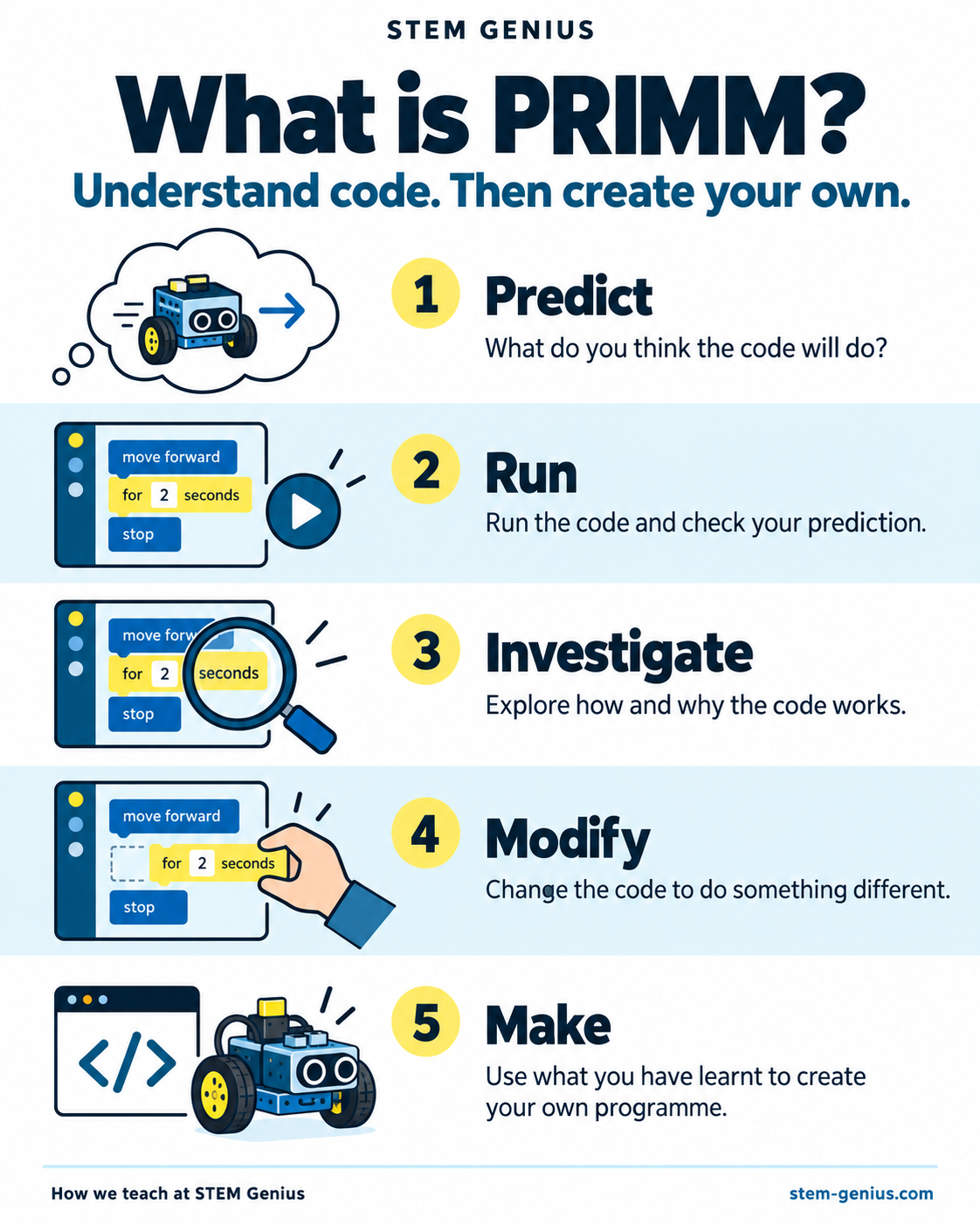
1 · Predict
Look at a programme and discuss what you think it will do before running it.
2 · Run
Run the programme and compare what happens with your prediction.
3 · Investigate
Explore how the programme works. Discuss the instructions and how changes affect its behaviour.
4 · Modify
Adapt the programme to change its behaviour or meet a new requirement.
5 · Make
Use what you have learnt to create a programme or solution of your own.
PRIMM is a programming teaching framework. Read more from the Raspberry Pi Foundation.
Our Stanford-inspired Design Thinking approach draws on the d.school framework. Children explore people’s needs, define a problem, develop ideas, build prototypes and improve their solutions through testing. This educational influence does not imply affiliation with or endorsement by Stanford.
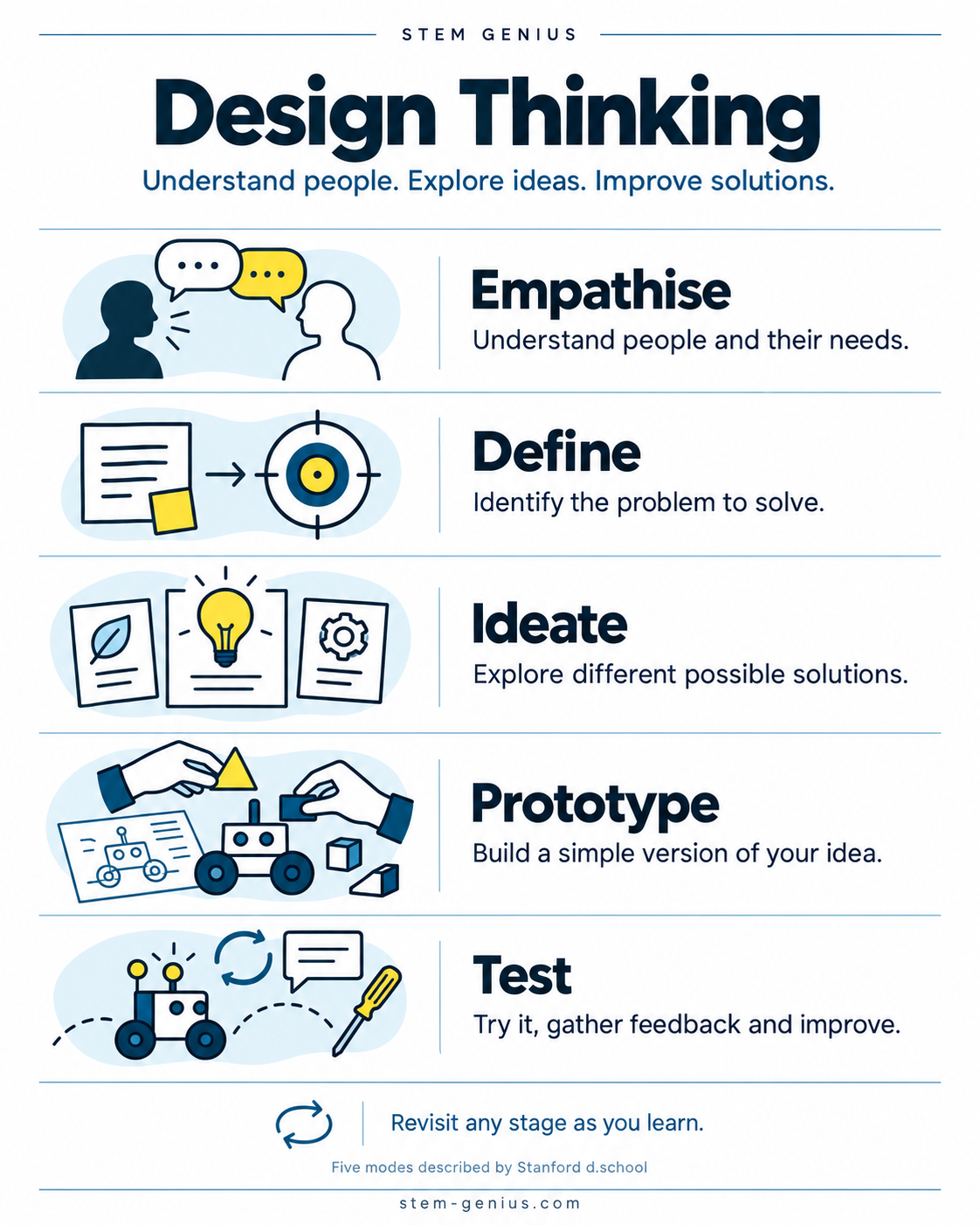
Empathise
Understand the people affected by a problem and what they need.
Define
Identify the problem the design should address.
Ideate
Explore possible solutions and consider different approaches.
Prototype
Build a version of the idea that can be tried out.
Test
Observe what works, identify what needs changing and improve the design.
Students can return to an earlier idea as they learn more. These modes are a flexible way of thinking, rather than a checklist that must be completed in every lesson.
Framework reference: Stanford d.school Design Thinking Bootleg.
Our MIT-inspired approach draws on constructionist and creative learning: children develop understanding by making projects they can test, discuss and improve. Through project-based learning, students are given real-life themes to work on. For example: how could we discourage pigeons from gathering at hawker centres, or reduce the manual work needed to keep Singapore clean? Students consider who is affected, propose ideas, build and code models or prototypes, then test and improve them. They explain their choices and reflect on what worked. These are classroom explorations of possible solutions. Small classes allow trainers to offer personalised prompts and feedback suited to each child’s progress. This educational influence does not imply affiliation with or endorsement by MIT.
Discover our robotics and coding classes, or speak with us about a suitable starting point for your child.