
STEM Genius Robotics Programme
Hands-On LEGO Robotics • Singapore
Children learn robotics by building, coding, testing and improving real projects. Our robotics pathway develops engineering thinking through LEGO robotics, motors, sensors, gears, mechanisms, programming and problem-solving.
Lessons are designed to help students understand why a robot behaves the way it does — not just copy a build or follow code step by step.

Key things to know before choosing a robotics class for your child.
Building and mechanisms, motors and movement, sensors, coding logic, debugging, problem-solving and how to improve a robot through testing.
No. We can recommend a suitable starting point based on your child's age, experience and confidence with building or coding.
Our current centres are in Chong Pang/Yishun and Clementi, Singapore.
Yes. Trials are S$45 at every WOR level: 60 minutes for WOR 1 and 90 minutes for WOR 2 and WOR 3. Enrol in regular classes within seven days and the S$45 is offset against the first month’s fees.
All equipment provided: no laptop or robotics kit purchase needed.
Three levels, from first builds to Python and AI robotics. Placement depends on student capability; ages are a general guide.
WOR 1
LEGO WeDo 2.0
Explore building, motors and sensors, then bring LEGO creations to life with code.
Generally ages 5+
60-minute lessons
S$45 trial
WOR 2
LEGO SPIKE Prime
Connect mechanisms, sensors and programming to build, test and improve robot solutions.
Generally ages 7+
90-minute lessons
S$45 trial
WOR 3
SPIKE Prime · Python · Pybricks · Raspberry Pi · AI
Explore image recognition, object detection and AI-assisted decision-making in robotics.
Placement by capability
90-minute lessons
S$45 trial
Not sure where to start? We’ll recommend a level based on your child’s building, coding and problem-solving capability. All equipment is provided.
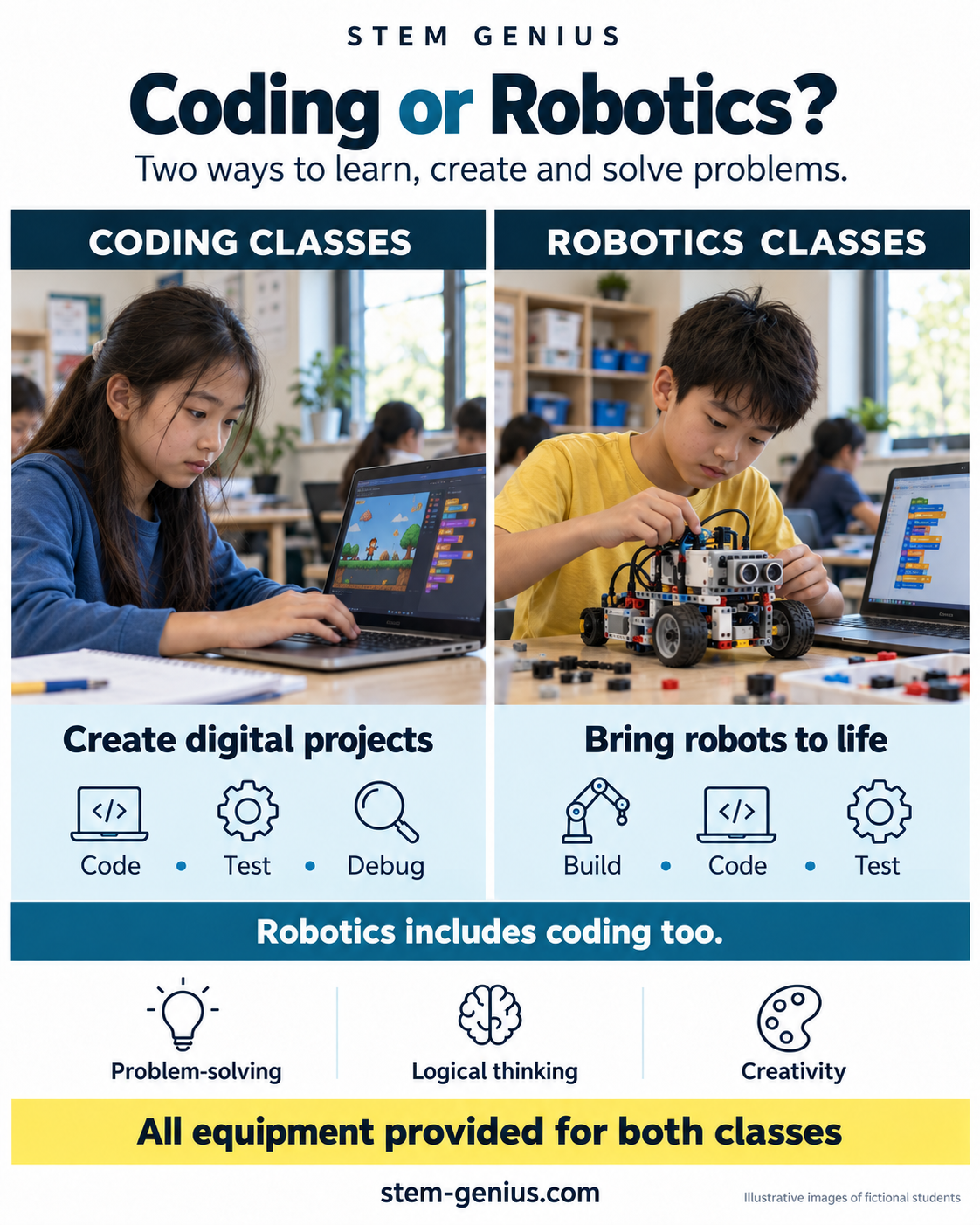
Coding classes: Children create digital projects while learning programming logic and debugging.
Robotics classes: Children build and programme physical robots, exploring motors, sensors and mechanisms. Robotics includes coding too.
Both develop problem-solving, logical thinking and creativity.
All equipment provided. We provide all equipment needed for our coding and robotics classes. Your child does not need to bring a laptop or purchase a robotics kit.
Students progress from mechanisms and sensors to coding and independent designs. PRIMM and Design Thinking guide how they predict, investigate, test and improve. See our teaching approach.
1
Mechanisms & Movement
Explore structures, gears, wheels, motors and how mechanical choices affect speed, torque and movement.
2
Sensors & Control
Use sensors so robots can detect colour, distance, force, orientation or changes in their environment.
3
Programming Logic
Develop sequencing, loops, conditions, functions and debugging habits while controlling real robot behaviour.
4
Projects & Challenges
Apply building and coding skills to open-ended challenges, refine ideas through testing and explain design decisions.
Robotics gives children opportunities to share ideas, solve problems together and contribute to a team. In this short student story, Bill shares his experience of teamwork at STEM Genius.
Student story: More Than Code: How Robotics Taught Bill Teamwork · 51 seconds. Shared with parent permission. Watch Bill’s story on YouTube.
STEM Genius offers robotics classes in Chong Pang/Yishun and Clementi. View our centre locations and contact details, or ask us which level suits your child’s experience.

Competition results are not the purpose of every robotics lesson, but they provide evidence that our training can progress to demanding real-world challenges.

NRC 2026 AIMS
Team Pyre and Team MSG
NRC Open 2026
Four STEM Genius teams reached the final
NRC Open 2025
Team Management
Code Olympiad 2025
Evidence of coding depth alongside robotics
See the teams and results behind these achievements. View STEM Genius Achievements →
STEM.org accredited · 1,000+ students taught over five years · People’s Association vendor with experience across 10 preschool and student-care organisations.
Robotics can become a deeper pathway for students who enjoy engineering, competition or STEM problem-solving.
Competition training challenges students to build more reliable robots, solve time-limited missions and improve through repeated testing.
Some Singapore secondary schools offer DSA talent areas related to Robotics, STEM, STEAM, Programming or Infocomm.
Students interested in the software side of robotics can deepen their programming through Elite Coder, Python and other coding pathways.
Structured coding assessments and certification-aligned pathways can provide additional checkpoints as programming skills develop.
Home kits support exploration. Classes add structured challenges, trainer feedback and peer discussion to help children understand and improve their designs.
Read our parent guide, or see the FAQ below.
Common questions from parents considering robotics lessons at STEM Genius.
No. STEM Genius provides all equipment needed for our coding and robotics classes. Your child does not need to bring a laptop or purchase a robotics kit.
Coding classes focus on creating digital projects while learning programming logic and debugging. Robotics classes combine building physical robots with programming their behaviour, using motors, sensors and mechanisms. Robotics includes coding too.
Both develop problem-solving, logical thinking and creativity.
No. We can recommend a suitable starting point based on your child’s experience with building, coding and problem-solving.
No. Building is only one part of the lesson. Students also learn how motors, sensors and mechanisms work, then code, test and debug the robot so it can complete a task or solve a challenge.
A LEGO robotics kit is a valuable way to explore at home, and children can learn independently with suitable resources and support. Classes add a structured learning pathway, trainer feedback and opportunities to work with other children.
At STEM Genius, students are guided to investigate how mechanisms and code work, test predictions, troubleshoot problems and improve their designs. Challenges become more independent as students develop their skills.
The goal is to help children understand and create, rather than simply finish a model. Home building can reinforce what they learn in class.
WOR 1 uses LEGO WeDo 2.0. WOR 2 uses LEGO SPIKE Prime. WOR 3 covers SPIKE Prime, Python, Pybricks, Raspberry Pi and AI, including image recognition, object detection and AI-assisted decision-making. Placement depends on student capability. All equipment is provided.
Our current centres are in Chong Pang/Yishun and Clementi.
Trials are S$45 at every level: 60 minutes for WOR 1 and 90 minutes for WOR 2 and WOR 3. If your child enrols in regular classes within seven days, the S$45 is offset against the first month’s fees.
Some secondary schools offer DSA talent areas related to Robotics, STEM or other technology fields. Robotics experience can help students build genuine skills and projects, but DSA admission is decided independently by each school and cannot be guaranteed.
Start with a hands-on robotics trial: 60 minutes for WOR 1 or 90 minutes for WOR 2 and WOR 3. Tell us your child’s age and experience so we can recommend a suitable level.